YOU'RE ALREADY HAVING THE CONVERSATION.

The one in your head — every car ride home, every rough week, the tryout that's two weeks out. Bring it here instead. Make it your edge.

Five real examples — pick one to watch ↓
After a tournament weekend

Your kid's information stays yours. We don't sell it, and we never use it to train AI models. And the kid never logs in — this is your space, not theirs.

For
Parents of athletes 6 to 18. The kid never logs in. It remembers everything — and gets to know your kid as an athlete better than anyone except you.
Every sport we cover
BasketballSoccerBaseballSoftballFootballHockeyField HockeyVolleyballTennisSwimmingGolfTrack and FieldLacrosseWrestlingGymnasticsCheerleadingDanceMartial Arts
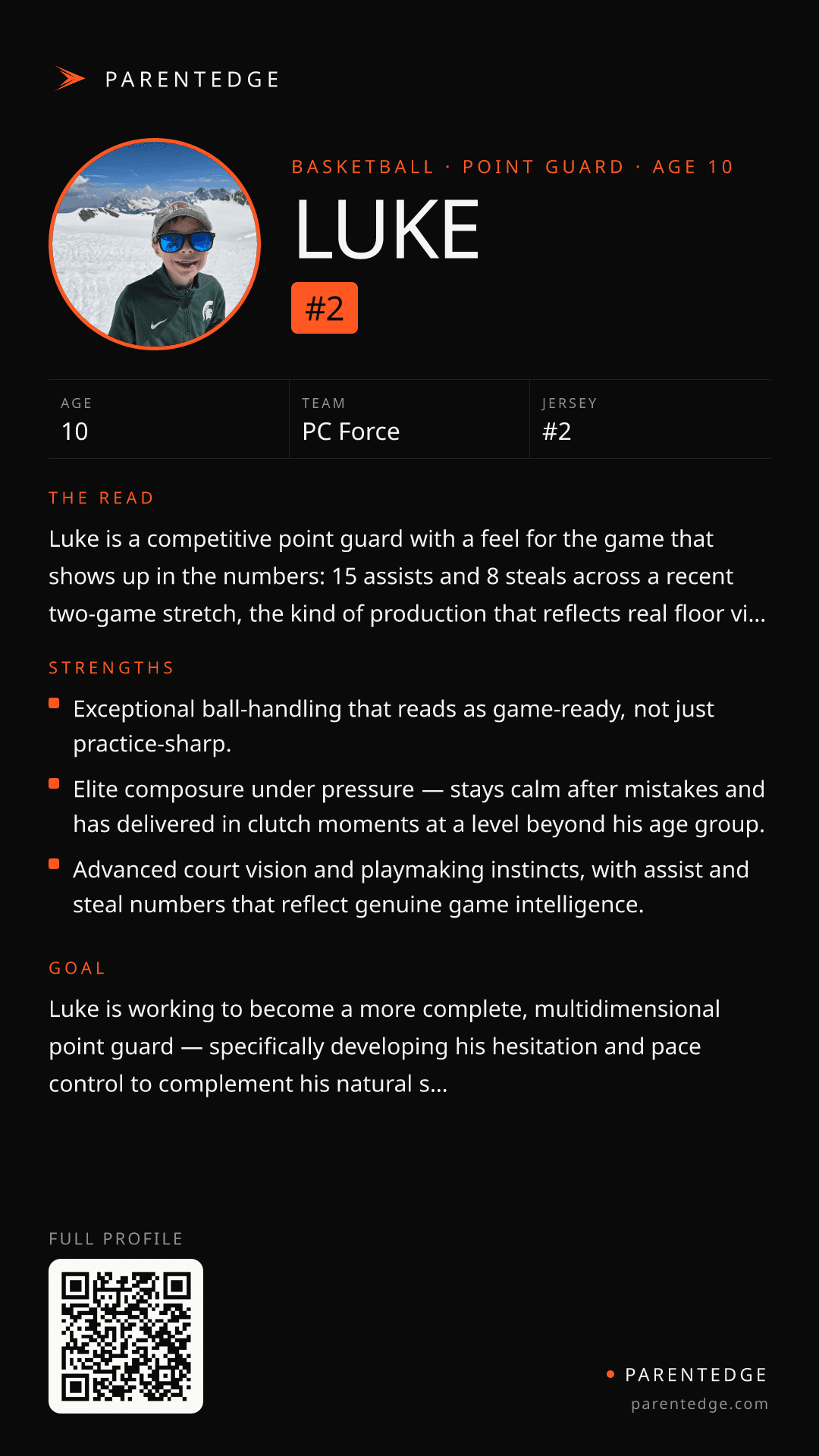
The Athlete Card

It builds from what you share — a living, always-updatable summary of who your kid is as an athlete. Share it with one click: family, a new coach, friends, anyone.

↓ what builds as you talkLive preview
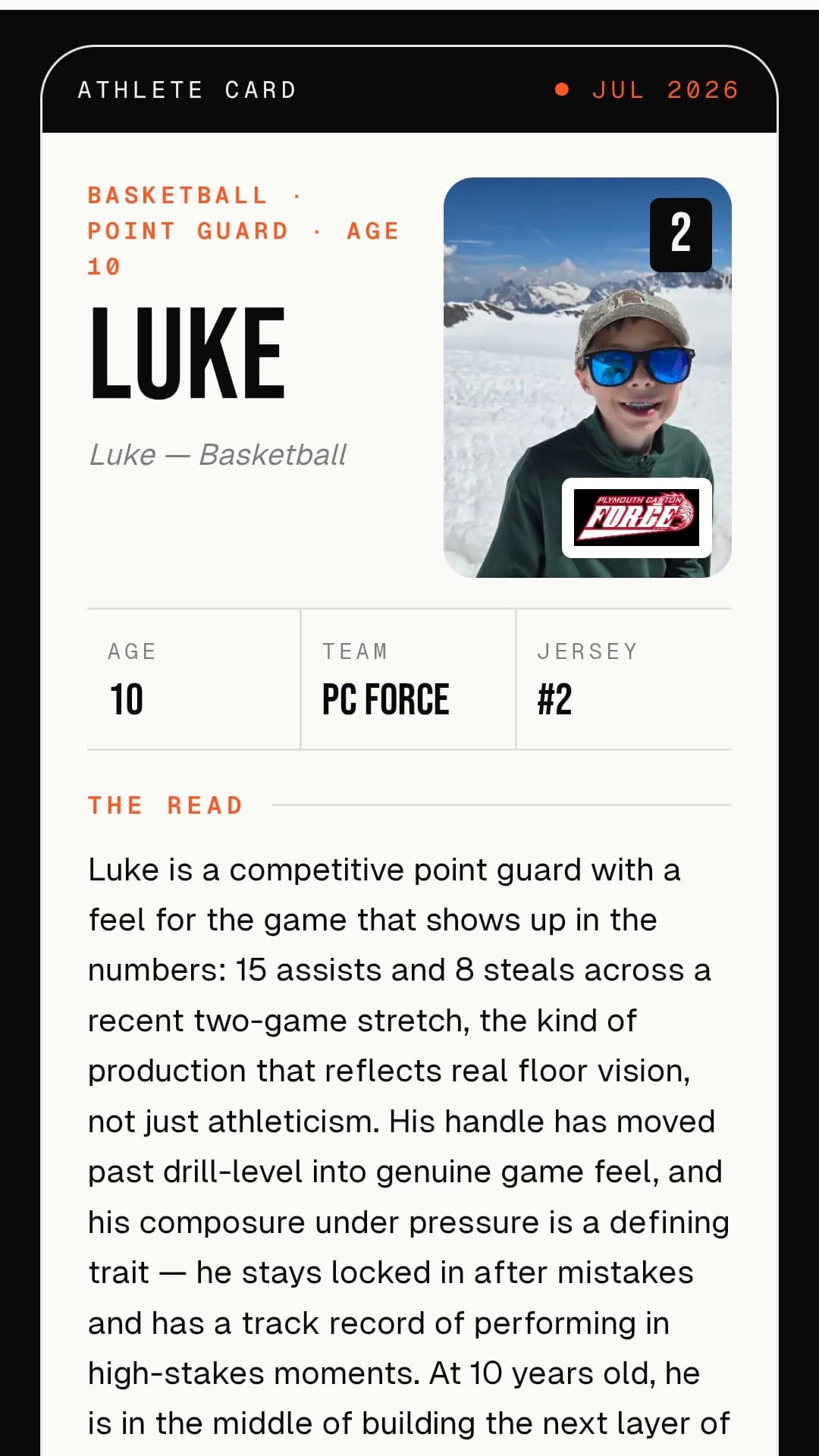
Athlete CardJul 2026
Basketball · Point Guard · Age 10
JAKE
Point guard with the ball on a string
Jake
2
AGE
10
TEAM
AC Dragons
JERSEY
#2
The read

Jake is a competitive point guard with a feel for the game that shows up in the numbers: 15 assists and 8 steals across a recent two-game stretch, the kind of production that reflects real floor vision, not just athleticism. His handle has moved past drill-level into genuine game feel, and his composure under pressure is a defining trait — he stays locked in after mistakes and has a track record of performing in high-stakes moments. At 10 years old, he is in the middle of building the next layer of his game: turning natural quickness and instinct into a more complete, deliberate point guard skill set.

Strengths
  • Exceptional ball-handling that reads as game-ready, not just practice-sharp.
  • Elite composure under pressure — stays calm after mistakes and has delivered in clutch moments at a level beyond his age group.
  • Advanced court vision and playmaking instincts, with assist and steal numbers that reflect genuine game intelligence.
  • Shooting range and mechanics that hold up under fatigue, with a 40-of-100 three-point clip logged during focused driveway work.
Goals

Jake is working to become a more complete, multidimensional point guard — specifically developing his hesitation and pace control to complement his natural speed, sharpening his left-hand finishing in traffic, and building confidence attacking the basket with floaters and off-balance finishes. He is also focused on tightening his shooting mechanics, his triple threat position, and his lateral quickness on the defensive end.

ParentEdgeUpdated Jul 2026
From one real season

WHAT IT ACTUALLY
MAKES FOR YOU.

Everything below was built from one family's real season — a ten-year-old point guard. We changed his name to Jake and his team's name, and that's it. This is the actual depth you get, not demo copy.

Built from what we’d told it that week — the back-rim misses, the one-speed problem. Nine drills, every one with a cue to say out loud. And the Run it button works — try it.

One drill at a time, with the timer — same as in the app
Practice Plan

Driveway Session: Handle, Lateral Movement, Shooting, and Floaters

Jake has the eyes-up habit and natural feel with the ball — this session builds on that by demanding he stays low through every transition and adds the hesitation pause he needs to become shiftier with the ball.


Warmup — 5 minutes

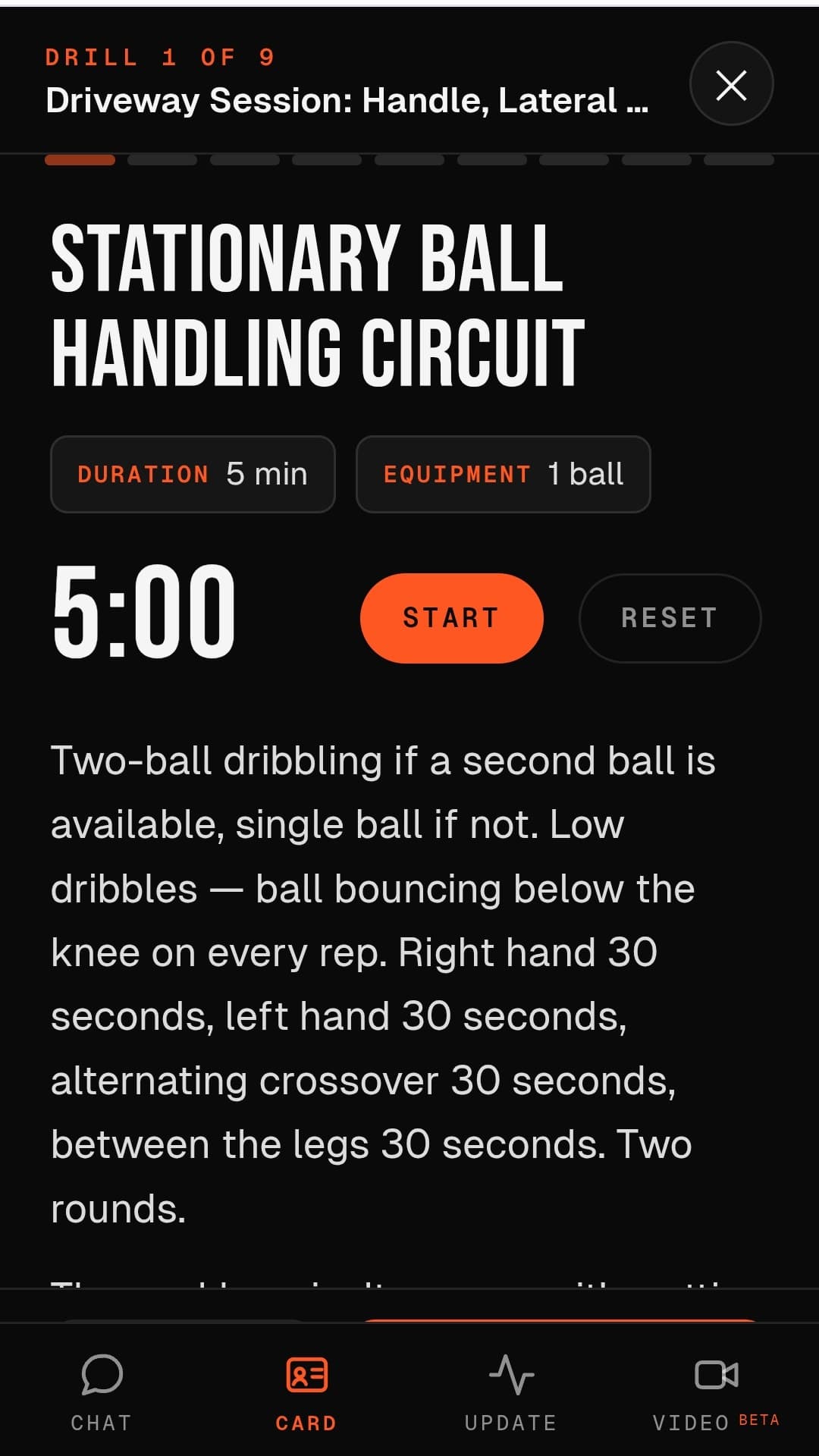
Stationary Ball Handling Circuit

Duration5 minEquipment1 ball

Two-ball dribbling if a second ball is available, single ball if not. Low dribbles — ball bouncing below the knee on every rep. Right hand 30 seconds, left hand 30 seconds, alternating crossover 30 seconds, between the legs 30 seconds. Two rounds.

The goal here isn't moves — it's getting the knees bent and keeping them there before anything else starts.

Coaching Cue

Cue: "Stay in the chair the whole time — if your head rises, the rep doesn't count."


Block 1: Handle and Lateral Movement — 20 minutes

Cone Attack with Hesitation

Duration8 minEquipment3-4 cones, 1 ball

Set three cones in a line, about 6 feet apart, running from the top of the key toward the basket. Jake starts at the first cone with the ball live. He attacks the second cone at pace, then freezes — body stops, ball keeps bouncing low, one full beat — then explodes past it. Same at the third cone. Walk back, repeat.

The freeze is the whole point. His body stops but the dribble never dies. That one beat is what makes a defender's feet stall. Right now Jake goes one speed — this teaches him that the pause before the move is what makes the move work.

Coaching Cue

Cue: "Body stops, ball lives. Freeze, then go."

Lateral Slide and Attack

Duration7 minEquipment2 cones, 1 ball

Two cones set 10 feet apart. Jake starts at the left cone in a low defensive-style stance, ball in his right hand. He slides laterally to the right cone — not running, sliding, feet never crossing — then attacks hard to the basket off the right cone for a finish. Walk back. Alternate which hand he attacks with on each rep.

The lateral slide keeps his hips low and wide. The attack off the cone should feel like a spring releasing — all that stored energy from the slide turning into an explosion.

Coaching Cue

Cue: "Slide low, explode high."

Retreat Dribble Into Attack

Duration5 minEquipment1 cone, 1 ball

Jake starts at the three-point line, attacks the cone (playing as a defender) hard, retreats one dribble back, and immediately attacks again. The retreat should be one controlled dribble — not two, not three. The moment the retreat dribble hits the ground, he's already deciding which direction he's going.

We've seen he does the retreat well but needs to make the second attack quicker and more decisive. This locks in that timing.

Coaching Cue

Cue: "One back, then go — no thinking."


Block 2: Shooting — 15 minutes

Form Shooting — Elbow Work

Duration5 minEquipment1 ball

Start 4-5 feet from the basket, directly in front. No dribble — catch, load, shoot. Ten reps right elbow, ten reps left elbow. The focus is sequencing: knees bend first, ball rises second. If the ball goes up before the knees load, the rep doesn't count. Hold the follow-through for two full seconds on every attempt — guide hand drops to the hip, shooting hand stays up.

Coaching Cue

Cue: "Sit before you shoot — legs first, always."

Dribble Into Pull-Up — Mid Range

Duration10 minEquipment1 ball

Two dribbles from the wing, pull up at the elbow for a mid-range jumper. Right side five reps, left side five reps, repeat twice. The dribble setup is Jake's strength — use it here. The pull-up is where the knee bend has to show up. He should feel his weight settle into the floor before the ball goes up.

Mix in a catch-and-shoot from the wing off an imaginary pass every third rep — ball already loaded when it arrives, feet already set. This is the read he needs for games: sometimes he's pulling up off the dribble, sometimes he's catching and shooting. Both need to feel the same in the legs.

Coaching Cue

Cue: "Weight down before the ball goes up."


Block 3: Floaters — 15 minutes

Elbow Floater — Footwork First

Duration7 minEquipment1 ball

Jake starts at the right elbow. One dribble hard toward the lane, gather off two feet at the block, float the ball up soft off the glass. Five reps right side, five reps left side. The gather is everything here — two feet landing together before the ball goes up, not a running one-foot jump. The floater isn't a layup. It's a shot released early before a rim protector can get to it. He needs to feel the difference between the two.

Coaching Cue

Cue: "Two feet land, then float — don't run into it."

Baseline Drive Into Floater

Duration8 minEquipment1 ball

Jake starts at the right baseline corner. He drives hard along the baseline into the lane, and instead of going all the way to the rim, he releases the floater at the near block — before the imaginary help defender gets there. Five reps right to left, five reps left to right. The left-to-right drive finishing with the right hand is his stronger direction — use it to build confidence. The right-to-left drive finishing left is where we need the reps.

The release point is key: if he feels like he went too far under the basket, he went too far. The floater lives in the lane, not at the rim.

Coaching Cue

Cue: "Release before the rim — early and soft."


Finish — 5 minutes

Free Throws — Focused Reps

Duration5 minEquipment1 ball

Ten free throws to close the session. One routine every single time — bounce twice, look at the rim, sit into the knees, shoot. No rushing. Given what we saw today with him hitting the back of the rim repeatedly, watch the release point: if he's going long, the ball is leaving his hand late and flat. The fix is releasing a beat earlier at the top of his jump, letting the wrist do the work rather than the arm pushing forward.

Coaching Cue

Cue: "Up and over, not out."


One thing to watch today: every time Jake resets between reps — standing still with the ball — check whether his knees stay bent or whether he straightens up. That habit between reps is the one that carries into games. If he's tall when he's waiting, he'll be tall when it matters.

Why month six sounds different from month one

ONE THREAD,
BUILT OVER YEARS.

Six months of one parent's thread — the way we remember it. Not a feed. A picture of a kid that keeps getting sharper, until we know him as an athlete better than anyone except you.

NOV
First week
Five-minute intake — basketball, point guard, age 10. You noticed: he hesitates on drives, lets defenders catch up. Fear of contact from behind. Staggered stance on shooting, misses tend short. We kept all of it.
JAN
First breakthrough
40 of 100 from three in practice. Real shooting percentage even by older standards. We started working catch-and-set timing — feet ready before the ball gets there.
FEB
Sharpening the handle
Built the inside-out and retreat-dribble plan. Two dribbles back instead of one — finally buying him space to attack again. Cue we both remember: “Back, back, go — three beats.”
MAR
Reading screens
Pick-and-roll work. He drives first off the screen, which is exactly right. We built the counter for when defenders hedge hard — snake the dribble, attack middle.
APR
Tournament weekend
Game-winning buzzer beater. 15 assists, 8 steals across two games. He led the scoring in the last two. The retreat dribble is showing up — defenders don't know what to do with it yet.
MAY
Where we are now
First-step explosiveness drills on the driveway. Plus a real sideline question from you: how to support him without getting in the way. Athlete Card is sharp enough to share with a new club coach this summer.
Whatever they're chasing
Elite success?We got you.
Making the team?We got you.
Feeling good about themselves?We got you.
Sharper skills, the right way?We got you.

Whatever you need for them in their sport — ParentEdge is there.

Made by a parent

I built this because I'm one of the parents it's for. You don't have to be a coach, and you don't have to know the sport cold — that's the whole point. You talk to it the way you'd talk to a friend who happens to know youth sports, and it remembers every word. Give it a few weeks and nothing it tells you is generic — it's all about your kid, drawn from everything you've shared.

— Chris, ParentEdge founder · a sports parent, same as you
What it sounds like

EVERY CONVERSATION
SHARPENS THE PICTURE.

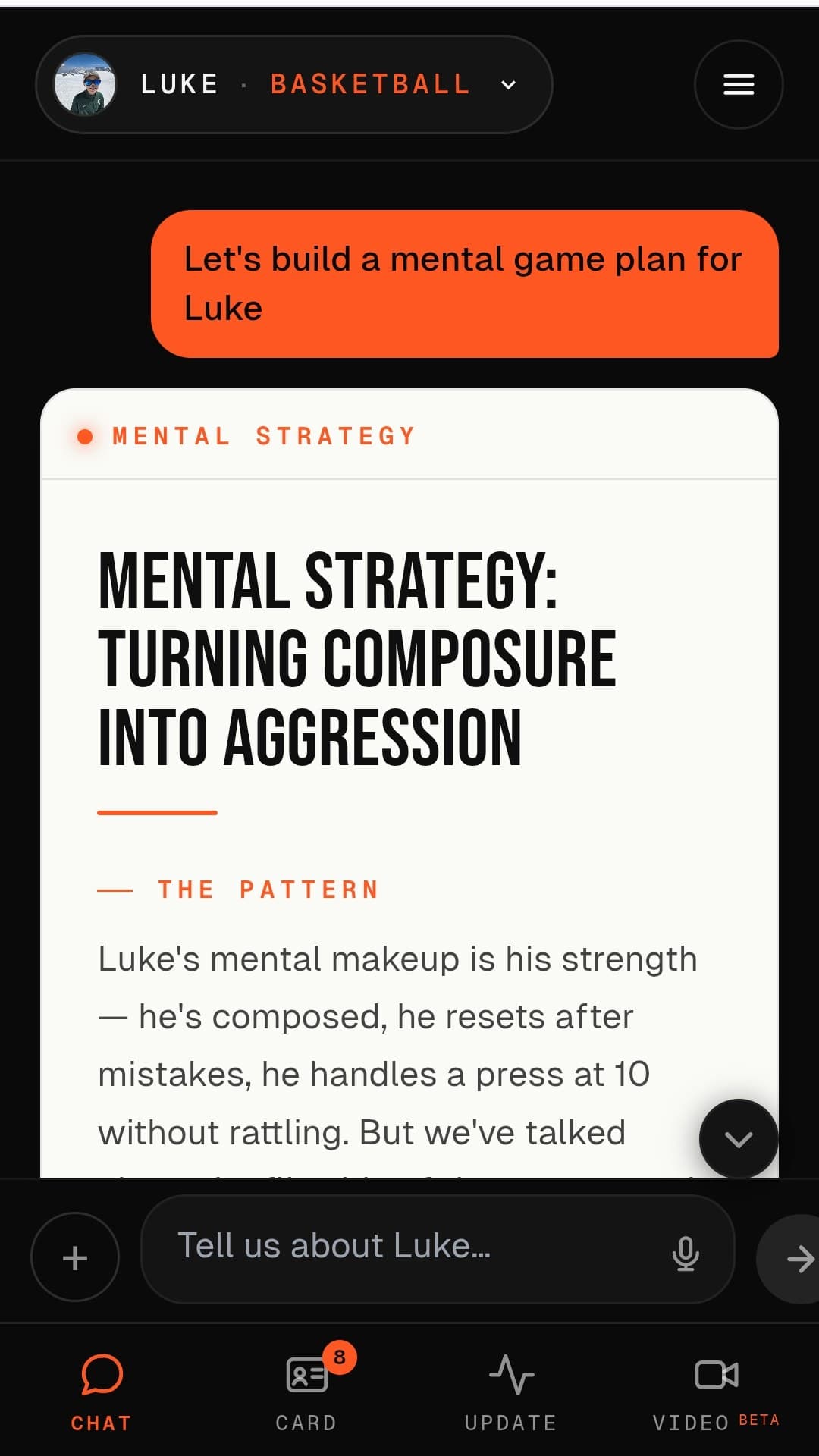
It remembers the bad race last week, the goal you set in November, and the tryout that's two weeks out — and it factors all of it into what it tells you today.

It remembers how he felt
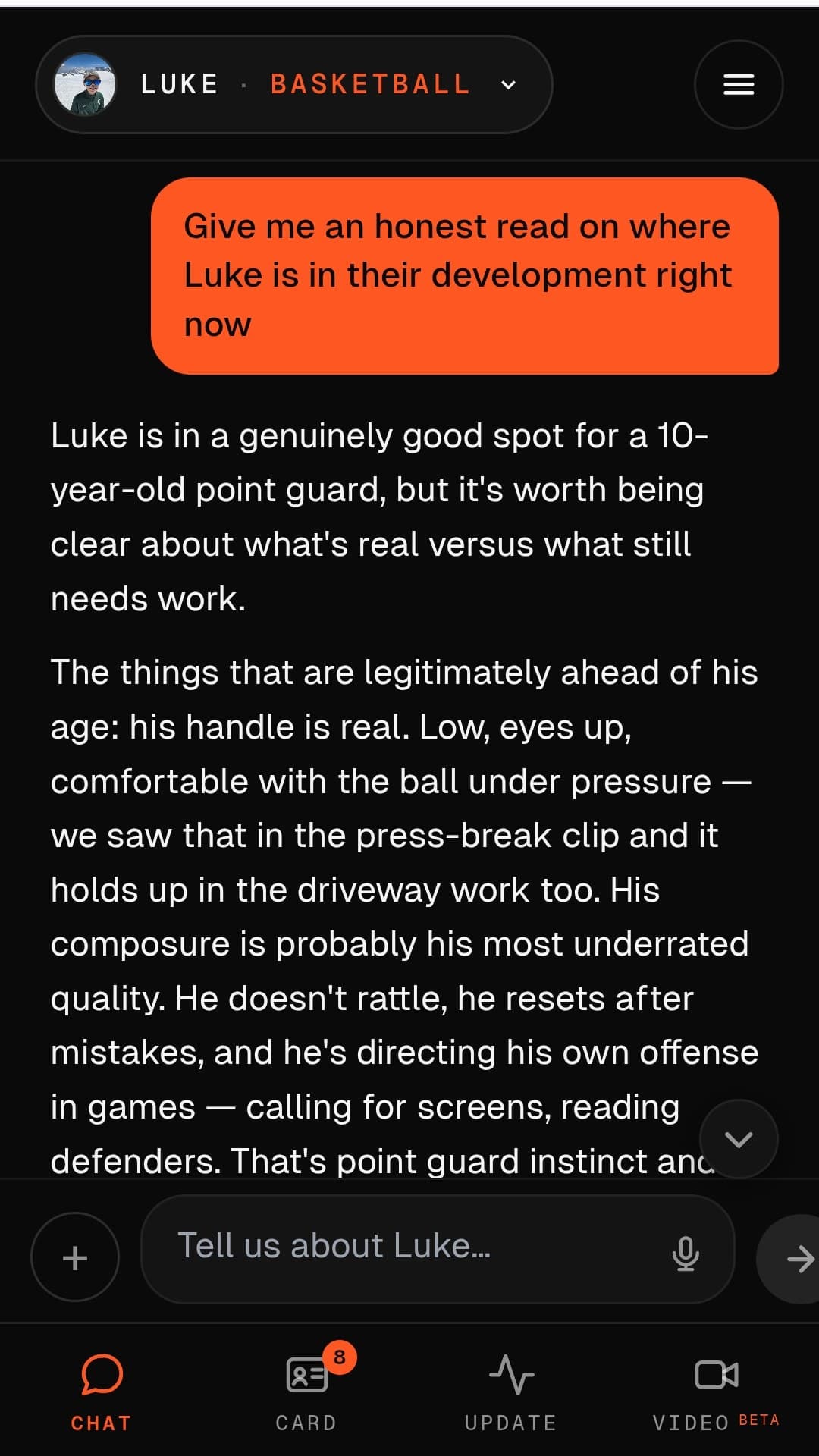
"He's still down about the race last Saturday — wouldn't talk the whole way home."
Last week clearly mattered to him, so let's not rush past it. One rough race doesn't move his season line — he's still well ahead of where he was in March. Want a short, low-pressure way to bring it up that puts the focus back on the next one?
It knows what's coming
"What should we be doing this week?"
Club tryouts are 11 days out, so I'd keep it sharp, not heavy — touch, first step, and confidence reps, nothing that leaves him sore. Want a light two-week runway that peaks the day before?
When the conversation needs paper

DRAWN FROM
WHAT WE ALREADY KNOW.

Got 30 minutes after school to work on his serve? A custom plan, built from everything we know about him. Want him training on his own this summer? Send it straight to his phone. New coach? Hand them his profile. Ask in plain language, have it in seconds — and none of it is a template. Every one is built for your kid, from what you've told us.

For the Athlete · For Jake · Basketball

Hey Jake

Here's what we're seeing heading into this week.

You had a big tournament. A game-winning buzzer beater, 15 assists, 8 steals across two games, and you led the scoring in the last two. That's not luck — that's you reading the game better than the kids around you. You've put in the work and it's showing up when it counts.

What you're doing well
Your court vision is genuinely special for your age. You're finding teammates before the defense even knows what's coming.
You hit the big shot when the moment was biggest. A lot of kids tighten up there. You didn't.
Your handles are getting sharper — the retreat dribble is coming along and defenders don't know what to do with it yet.
One thing to focus on this week

Every time you make a pass, your eyes go straight to the ball — not to where you're running, not to your man, not to the sideline. Ball first, every single time. Do it in practice, do it in drills, do it until you don't have to think about it anymore. That one habit is what takes a good point guard and makes him a great one.

Keep going

The work you're putting in is real and it's adding up. You're 10 and you're already making plays that older kids can't make. Stay locked in this week — the best version of your game is still ahead of you.

Developmental guidance only — not professional coaching, medical, or psychological advice.

parentedge · parentedge.comFor the Athlete · For Jake
30 minutes after school

Custom Serve Session

A 30-minute plan built around his level and what he's been working on — toss consistency, contact point, then live serves under a little pressure.

4 drills · 30 minOpen →
Training on his own

Summer Solo Workout

An hour he can run by himself. Print it, or send it straight to his phone — drills targeted at exactly where he is right now.

Sent to his phoneOpen →
For a new coach

Athlete Profile

Everything about him in one place — strengths, goals, accomplishments — current as of today. Hand it over before the first practice.

Updates anytimeOpen →
Also produced: skill roadmaps · goal worksheets · pre-game routines · weekly summariesSee all outputs →
From real parents

Sent the profile to her new coach before the first practice. He referenced it in their first one-on-one. That was the moment I got it.

Jordan T.
Swim parent · Age 14

START THE
CONVERSATION.

Five minutes of setup and we'll already have a picture of your athlete. From there, we keep going — every car ride, every tough week, every weekend tournament. Try it free today.

Your kid's information stays yours. We don't sell it, and we never use it to train AI models. And the kid never logs in — this is your space, not theirs.